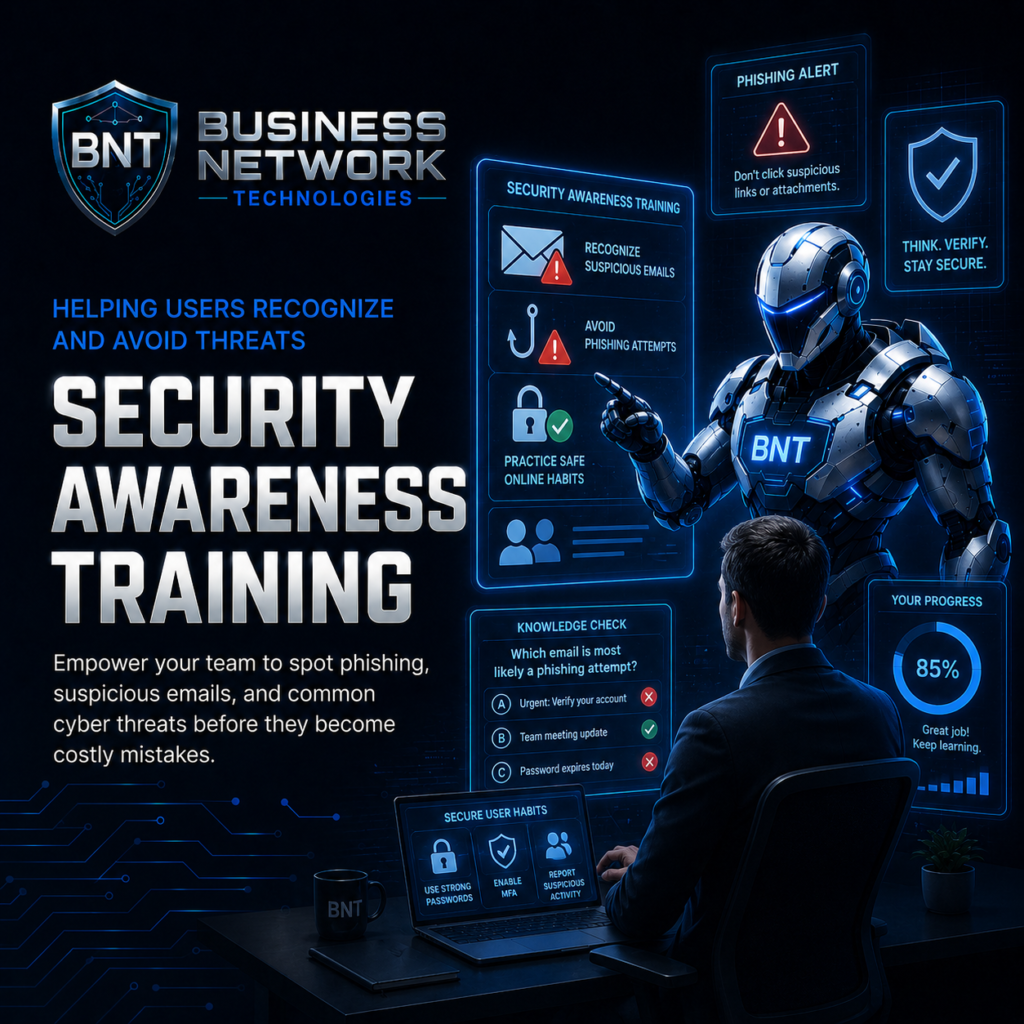
Here is a deeper, business-owner-friendly version of the Security Awareness Training description:
Security Awareness Training
Helping your employees recognize cyber threats before they become costly mistakes.
Technology is an important part of cybersecurity, but your employees also play a major role in protecting your business.
Many cyberattacks do not start with a hacker breaking through a firewall. They often start with a simple email that looks real. An employee may receive a fake invoice, a message that appears to be from Microsoft, a request from someone pretending to be a vendor, or an email that looks like it came from a manager or business owner.
If the employee clicks a bad link, opens a dangerous attachment, enters a password on a fake login page, or responds to a fraudulent request, the business can be exposed.
Security awareness training helps teach your staff what to watch for, how to slow down before clicking, and what to do when something looks suspicious.
Why Security Awareness Training Matters
Most employees are not trying to put the business at risk. They are busy doing their jobs. Cybercriminals know this, so they create emails and messages that look urgent, familiar, or believable.
These attacks may look like:
• A fake Microsoft 365 login request
• A fake invoice from a vendor
• A request to update banking information
• A suspicious attachment
• A fake password expiration notice
• A message pretending to be from the owner or manager
• A delivery notification with a malicious link
• A request for gift cards or wire transfers
• A document-sharing link that leads to a fake login page
One mistake can lead to a compromised email account, stolen password, ransomware infection, financial fraud, or sensitive business information being exposed.
Security awareness training helps reduce that risk by giving employees practical guidance they can actually understand and use.
What Security Awareness Training Means for Your Business
Security awareness training is not about turning employees into cybersecurity experts. It is about helping them recognize common warning signs and make better decisions when something seems suspicious.
For a business owner, this means your employees are better prepared to stop and think before clicking, opening, replying, or entering information.
Good training helps employees understand:
• What phishing emails look like
• Why fake invoices are dangerous
• How attackers try to steal passwords
• Why multi-factor authentication matters
• How to avoid unsafe links and attachments
• Why urgent requests should be verified
• Who to contact when something looks suspicious
• What to do if they accidentally click something
The goal is to create safer habits across the business.
BNT helps strengthen your business security with practical security awareness training that may include:
• Phishing awareness training
Phishing emails are designed to trick employees into clicking links, entering passwords, opening attachments, or giving away information. Training helps employees recognize suspicious emails before they become a problem.
• Fake invoice and payment scam awareness
Businesses are often targeted with fake invoices, wire transfer requests, banking change requests, and payment scams. Training helps employees understand why financial requests should be verified before action is taken.
• Suspicious email identification
Employees learn how to look for warning signs such as unusual sender addresses, urgent language, unexpected attachments, strange links, spelling mistakes, and requests that do not seem normal.
• Password security best practices
Employees learn why strong, unique passwords matter and why reusing passwords across multiple websites can create serious business risk.
• Multi-factor authentication awareness
Training helps employees understand why MFA is important and why they should never approve a login request they did not initiate.
• Safe internet and link-clicking habits
Users learn to be cautious with unknown websites, pop-ups, shortened links, suspicious downloads, and emails asking them to “click here” without verifying the source.
• Social engineering awareness
Social engineering is when attackers manipulate people instead of technology. This may include pretending to be a vendor, employee, manager, bank, software provider, or customer to get information or money.
• Security policy reminders
Employees are reminded of basic business security expectations, such as not sharing passwords, locking computers, reporting suspicious emails, and handling sensitive information carefully.
• Phishing simulation campaigns
Simulated phishing emails can be used to test employee awareness in a safe way. This helps identify who may need additional training before a real attack happens.
• Employee reporting guidance
Employees should know exactly what to do when they receive something suspicious. Training helps them understand who to report it to and why fast reporting matters.
• Cyber insurance training support
Many cyber insurance providers ask about employee security awareness training. BNT can help support this requirement by helping businesses show that users are being educated.
• Ongoing user education
Cyber threats change over time. Ongoing reminders and training help keep security awareness fresh instead of treating it as a one-time event.
Common Mistakes Security Awareness Training Helps Prevent
Security awareness training can help reduce common employee mistakes such as:
• Clicking phishing links
• Opening unsafe attachments
• Entering passwords on fake websites
• Approving unexpected MFA prompts
• Sending money based only on an email request
• Trusting fake invoices
• Sharing passwords
• Ignoring suspicious account activity
• Failing to report a suspicious message
• Reusing business passwords on personal websites
These mistakes are common, but many can be reduced when employees know what to look for.
Why Employee Training Is Part of Cybersecurity
Cybersecurity is not just software, firewalls, antivirus, and monitoring. Those tools are important, but people are often the first target.
Attackers know it may be easier to trick a person than to break through a security system. That is why employee training is an important layer of protection.
When employees are trained properly, they become more cautious, more confident, and more likely to report suspicious activity before it causes damage.
A Practical Approach to Training
BNT focuses on security awareness training that is practical and easy to understand. Your employees do not need complicated technical lessons. They need clear examples, simple rules, and real-world guidance that applies to the emails and situations they see every day.
Security awareness training helps your business:
• Reduce phishing risk
• Improve employee decision-making
• Protect Microsoft 365 accounts
• Reduce password-related risks
• Prevent fake invoice scams
• Strengthen cyber insurance readiness
• Create a more security-aware workplace
• Lower the chance of costly mistakes
We focus on helping employees become a stronger line of defense, because cybersecurity is not just about technology — it also depends on informed users making better decisions.
Call or Email to Learn More About Security Awareness Training